Designing a successful exhibition stand is not simply about making a small space look attractive. When designing small exhibition stands in Saudi Arabia, the challenge runs deeper: how do you create a meaningful brand experience within a compact footprint while maintaining clarity, visibility, and visitor flow?
The Challenge of Visually Integrating Several Brands in a Country Exhibition Pavilion
When several companies need to share one compact exhibition environment, the real challenge is much more complex: How can every brand be visible, the overall stand design remain coherent, and visitors move naturally through the space without feeling overwhelmed? This is a core question in multi-brand exhibition stand planning, and it is one our team faced when designing the compact exhibition stand of the Austrian Pavilion in Riyadh.
Earlier this year, we developed an exhibition design proposal for Advantage Austria for Big 5 Construct Saudi in Riyadh. Although the planned activation ultimately did not go ahead due to circumstances caused by recent geopolitical developments, the project created an interesting opportunity to explore a question that is highly relevant to global exhibition design trends and experience-driven retail design in Saudi Arabia:
How do you create a strong brand experience when you have very little space?
For us, the answer starts with planning the exhibition customer journey based on the behavior and preferences of local visitors. Exhibition stand design is not the same as decoration.
Key Design Principles for Designing Small Exhibition Stands
A Small Space Requires More Design Thinking, Not Less
In a large exhibition stand, there is room to create separate zones for reception, product presentation, meeting areas, hospitality, and branding. A compact exhibition stand does not offer that luxury. Every square meter needs to perform a function. This is a core principle when contemplating how to design a small exhibition stand.
In the Advantage Austria country stand concept, multiple Austrian companies needed to be represented within one shared environment. The proposal therefore had to balance:
individual company visibility
Advantage Austria branding
visitor circulation
meeting and hospitality areas
product and graphic displays
reception
storage
sightlines from the exhibition aisle
a clear overall identity
The space distribution was carefully organized so that exhibitors received defined presentation areas while the Advantage Austria lounge and shared seating supported interaction. The design proposal allocated specific display and branding elements to each participating company.
Don’t Start with the Furniture. Start with the Journey
The first principle when designing exhibition stands is therefore always planning the visitor flow, especially in compact exhibition stands where this is often overlooked.
Before deciding what a wall or a counter should look like, we ask:
Where does the visitor come from?
What do they see first?
Which elements should attract their attention?
How can all brands have equal visibility?
Where do they naturally stop?
Where can a conversation happen?
How can visitors move to the next company without feeling that they are entering a completely different stand?
This way of thinking can turn a small stand into a high-impact customer journey.
Exploring Different Design Directions for One Exhibition Concept
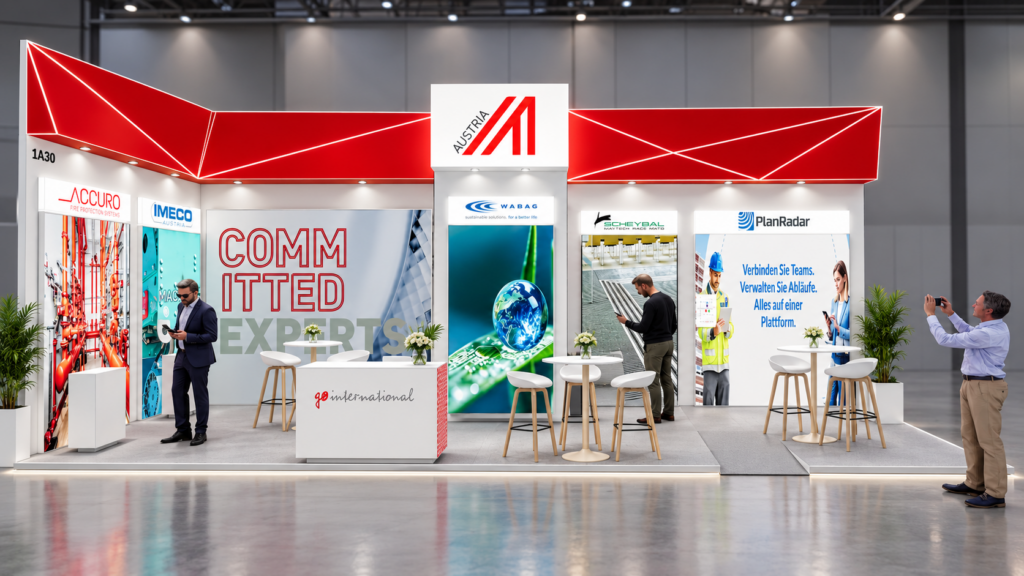
For the Advantage Austria project, we explored several visual approaches before developing the final direction. The three options demonstrated how the same basic program can produce very different experiences.
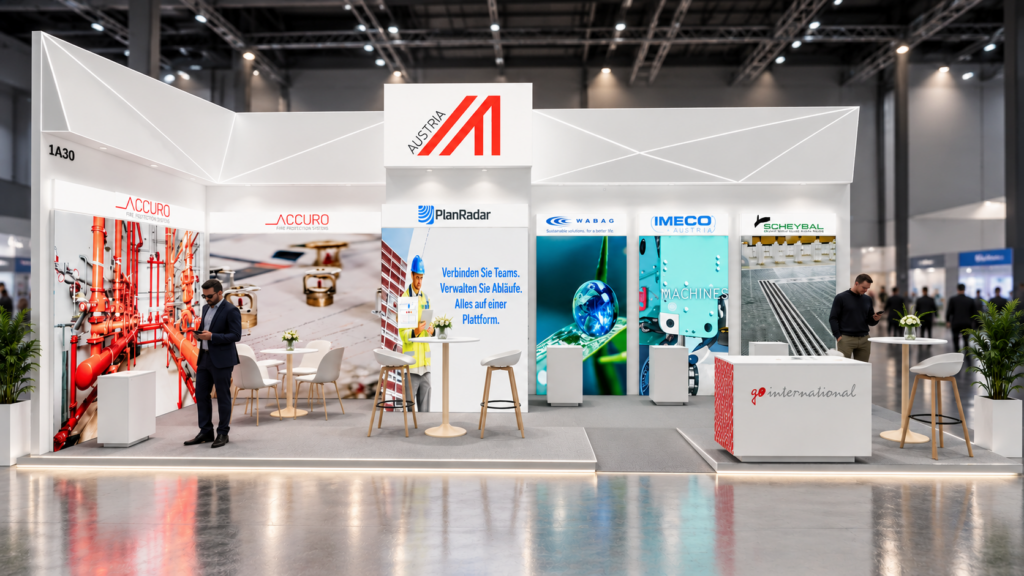
Option 1 – Clean and Modern: A Lighter, Architectural Approach
The first direction explored a predominantly white architectural structure. The focus was on openness, transparency, and allowing the individual exhibitor graphics to become the strongest visual elements.
This approach creates a relatively calm environment. It can work particularly well when multiple brands already have strong colors, photography, or product imagery that need to remain visually dominant.
The advantage is flexibility. The risk is that a very neutral exhibition structure can become less distinctive when surrounded by many other exhibitors.
Option 2 – Austrian and Memorable: A Graphic, Linear Approach
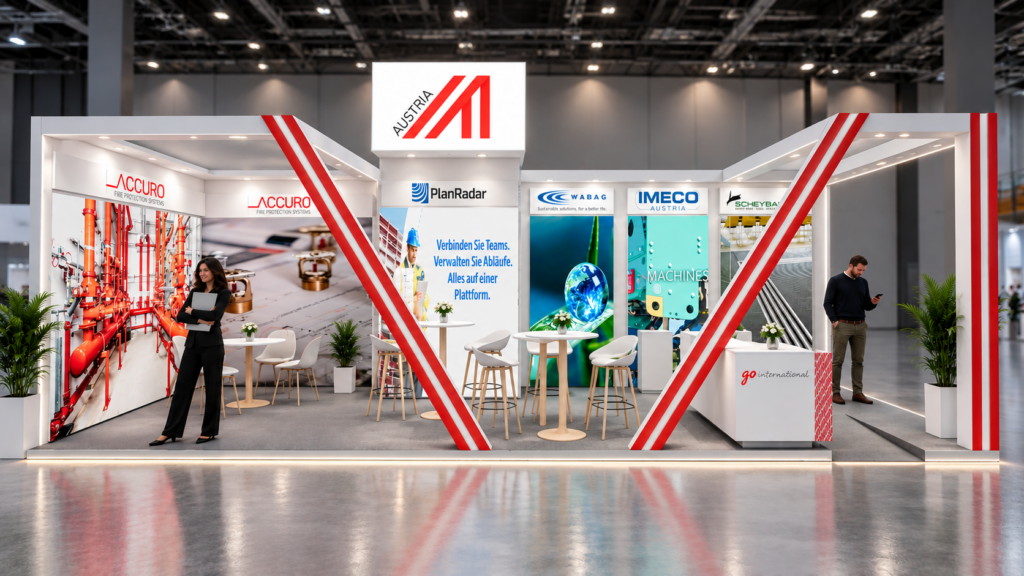
The second direction introduced stronger graphic lines and red diagonal elements into the architecture. Instead of relying only on wall graphics, the structure itself became part of the brand language.
This is an important principle in contemporary exhibition stand design that is especially relevant in dynamic markets such as the Middle East and Saudi Arabia:
Branding should not only sit on the architecture. It can become part of the architecture.
Large graphic elements can create recognition from a distance, while architectural lines can guide the eye towards the entrance and key meeting areas. For a compact stand, this is particularly useful because the architecture itself becomes a communication tool.
Option 3 – Color Impact: The Selected Red Architectural Concept
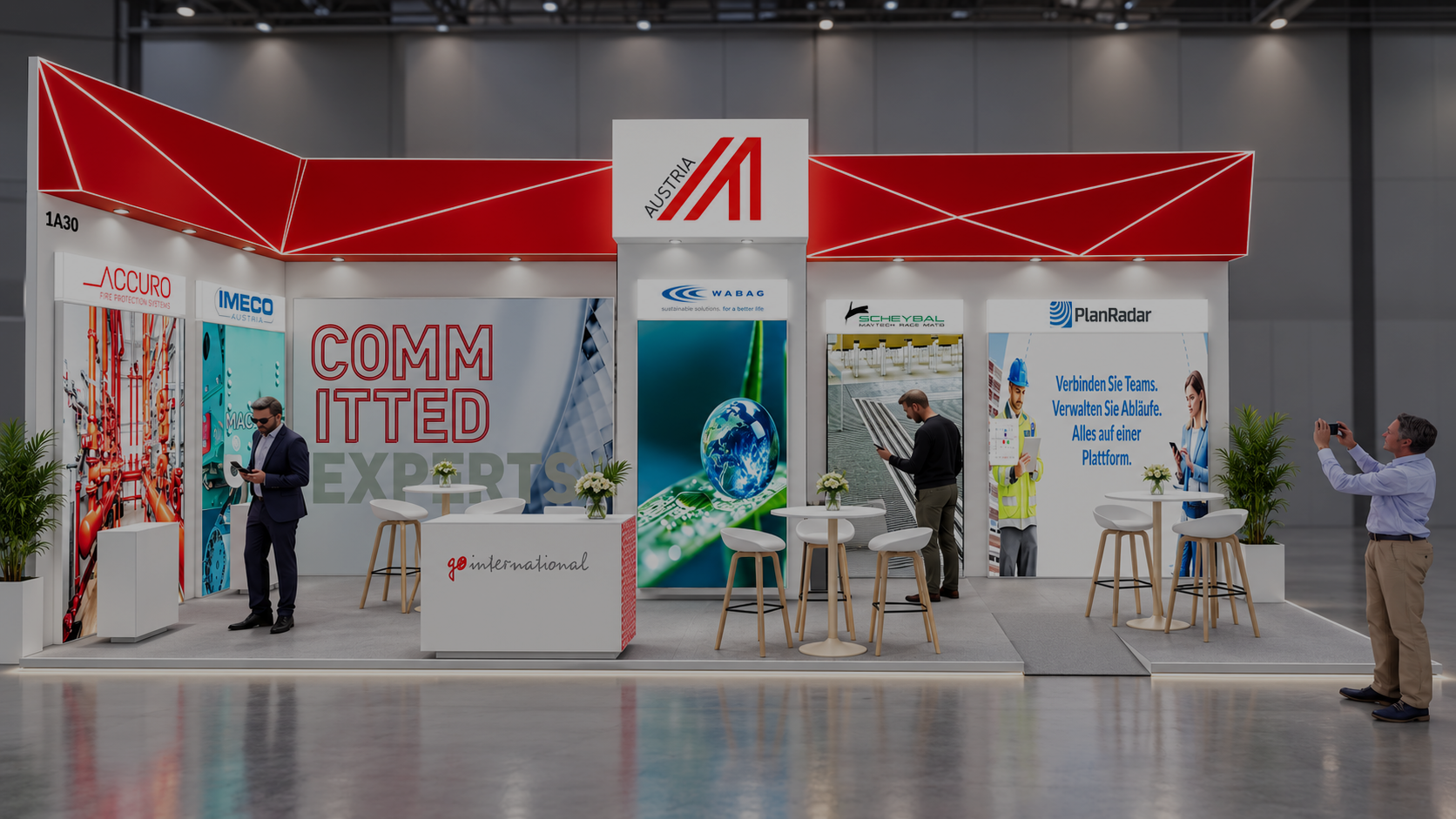
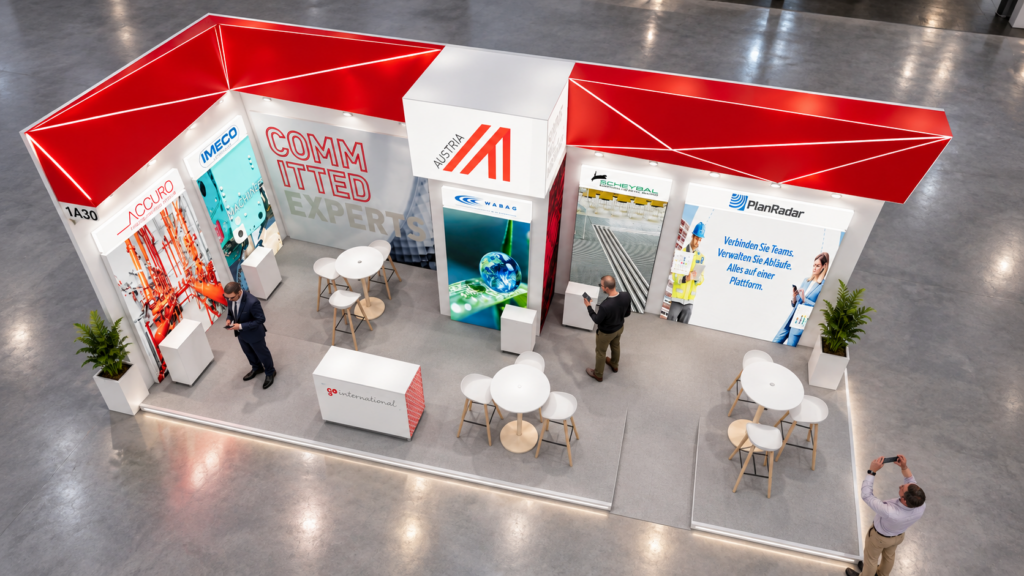
The selected concept used a diamond-inspired 3D structure, with strong red surfaces and white LED strip lighting along the architectural borders. The result was a more dynamic and powerful visual identity while maintaining a relatively clean exhibition environment.
This option was particularly effective because it solved two problems at the same time: visibility from a distance and brand recognition at close range.
The final direction pushed the visual identity further. From the exhibition aisle, the red architectural frame creates a strong silhouette. Once visitors approach, the individual companies become visible through their dedicated graphics and displays.
This creates a three-stage communication strategy: 1. Attract; 2. Inform; 3. Engage and that is the foundation of a successful exhibition customer journey.
Transformation of the Retail Design and Exhibition Stand Design Market in Saudi Arabia and the Middle East
Saudi Arabia’s retail environment is undergoing significant transformation, particularly in Riyadh and Jeddah. Recent market research points towards a stronger emphasis on experience-focused retail environments, with developers increasingly incorporating entertainment, dining, and other experiential components.
That shift has implications beyond traditional shops. The same expectation for experience, interaction and strong visual identity is increasingly relevant to brand activations, pop-ups, showrooms and exhibition environments. For designers working in retail design in Saudi Arabia or the Middle East, this means that a successful space should not only answer:
“What does the brand want to show?” It should also answer: “What does the visitor want to experience?” That distinction is fundamental.
Turning Limited Space Into a Meaningful Experience
At 5 Star Plus Retail Design, we create exhibition stands, retail environments and brand experiences that combine strategic space planning, strong visual identity and customer-focused design. Whether you are planning a compact exhibition stand anywhere in the world, a retail concept, a showroom or a brand activation, our team can help you turn limited space into a meaningful customer experience.